

Introduction: Origins, Culture and Power
The Asaf Jahi dynasty, widely known as the Nizams of Hyderabad, was a Muslim ruling dynasty that governed the princely state of Hyderabad in the Deccan region of India from 1724 until 1948. Its founder, Mir Qamar-ud-Din Khan, later known as Asaf Jah I, was a nobleman and military commander in the Mughal Empire. His family belonged to the Persianate political and cultural world of the Mughal court, with Central Asian and Persianate influences shaping the dynasty’s elite traditions, administration and military organisation. The family traced its ancestry to a distinguished Muslim lineage, although particular claims about its more ancient genealogical origins should be distinguished from independently established historical evidence. The Nizams followed Islam, and their court culture was strongly influenced by Persian language and literary traditions, alongside the Deccani Urdu, Telugu, Marathi and Kannada cultures of the regions they governed. Their military forces included cavalry, infantry, artillery and, in later periods, European-trained units. However, their military power changed considerably over two centuries as the Marathas, Mysore, European trading companies and eventually the British East India Company became major forces in Indian politics. Hyderabad developed into one of the largest and wealthiest princely states in British India, with its own administration, revenue system, currency and, for periods, railway and postal services. The Nizams became known for their palaces, philanthropy, patronage of education and the arts, and the distinctive Indo-Islamic and Deccani culture that flourished under their rule.
The Rise of the Nizams: How Asaf Jah I Established His Rule
The Asaf Jahi dynasty emerged during the weakening of Mughal authority in the early eighteenth century. Its founder, Mir Qamar-ud-Din Khan (Asaf Jah I, 1671–1748), rose through the Mughal imperial administration as a capable governor, statesman and military commander. He held important provincial appointments, including the governorship of the Deccan, but his position was repeatedly affected by rivalries at the imperial court. In 1724, he defeated Mubariz Khan, the Mughal-appointed governor who opposed his authority, at the Battle of Shakar Kheda in the Deccan. This victory enabled him to establish effective control over the region. Although Asaf Jah I continued to acknowledge the Mughal emperor’s formal sovereignty, he exercised substantial independent authority over his territories, appointing officials, managing revenues and maintaining his own military forces. His rule marked the beginning of the Asaf Jahi state, which gradually became centred on Hyderabad. His successors inherited this regional power, but the early decades were turbulent: rival claimants within the family and competing French and British interests intervened in Deccan politics. Under Asaf Jah II, who ruled from 1762 to 1803, Hyderabad entered into an increasingly consequential relationship with the British East India Company. The dynasty survived these challenges, but its rulers gradually surrendered much of their freedom in external affairs to British influence.
Rulers of the Asaf Jahi Dynasty
The dynasty had seven principal rulers bearing the formal Asaf Jah titles. However, three other claimants ruled during the succession crisis following the death of Asaf Jah I, so they are included below to provide a fuller political chronology.
| Time period | Ruler name | Key significance during that reign |
|---|---|---|
| 1724–1748 | Asaf Jah I — Mir Qamar-ud-Din Khan | Founded the Asaf Jahi state, defeated Mubariz Khan and established autonomous rule in the Deccan while nominally recognising Mughal authority. |
| 1748–1750 | Nasir Jung | Son of Asaf Jah I; became embroiled in succession conflicts involving rival claimants and European-backed factions. |
| 1750–1751 | Muzaffar Jung | Grandson of Asaf Jah I; gained power with French support but was killed during a campaign in 1751. |
| 1751–1762 | Salabat Jung | Ruled amid growing French influence and competition among Deccan powers; was eventually deposed by his brother Nizam Ali Khan. |
| 1762–1803 | Asaf Jah II — Nizam Ali Khan | Consolidated Hyderabad’s position but entered into arrangements with the British East India Company that increasingly restricted the state’s independence. |
| 1803–1829 | Asaf Jah III — Sikandar Jah | Continued under growing British influence; Hyderabad’s political and military autonomy was increasingly constrained. |
| 1829–1857 | Asaf Jah IV — Nasir-ud-Daula | Faced serious financial and administrative difficulties; British control over state affairs deepened. |
| 1857–1869 | Asaf Jah V — Afzal-ud-Daula | Reigned during the Indian Rebellion of 1857; administrative and infrastructure reforms continued, including developments in public works. |
| 1869–1911 | Asaf Jah VI — Mahbub Ali Khan | Oversaw modernisation of administration and public services; Hyderabad expanded its educational, medical and infrastructure institutions. |
| 1911–1948 | Asaf Jah VII — Mir Osman Ali Khan | Last ruling Nizam; Hyderabad developed modern institutions and infrastructure but faced growing pressure to join independent India. |
Chronological note: Nasir Jung, Muzaffar Jung and Salabat Jung are often treated separately from the seven formally numbered Asaf Jah rulers. Their inclusion here reflects the actual succession struggles after 1748 rather than implying that all three held the same dynastic title.
Historical basis: Encyclopaedia Iranica, the University of Hyderabad’s historical material and studies of the legal and administrative systems of Hyderabad.
Cultural and Economic Influence of the Nizams
The Nizams profoundly shaped the cultural, architectural, educational and economic development of Hyderabad and the surrounding Deccan. Their court blended Persianate traditions with local Telugu, Marathi, Kannada and Deccani Muslim cultures, helping Hyderabad become a major centre of Urdu literature, poetry, music, cuisine and craftsmanship. Royal patronage supported palaces, mosques, gardens and public buildings, while Hyderabad’s distinctive architecture combined Indo-Islamic forms with regional and European influences. During the later nineteenth and early twentieth centuries, the state developed modern administrative departments, railways, hospitals, educational institutions and public infrastructure. Osmania University, founded in 1918 under Mir Osman Ali Khan, became particularly significant for its use of Urdu as a medium of higher education. The Nizam’s government also supported institutions such as hospitals and libraries, while Hyderabad became known for its banking, textiles, metalwork, pearls and diamond trade. Nevertheless, the benefits of these developments were unevenly distributed, and the state retained significant social and economic inequalities. The Nizams’ legacy is therefore both a story of cultural patronage and institutional modernisation and a reminder of the limitations of princely governance. Many of Hyderabad’s cultural traditions and historic buildings remain important parts of the region’s identity today.
Territories Under the Nizams at Their Greatest Extent
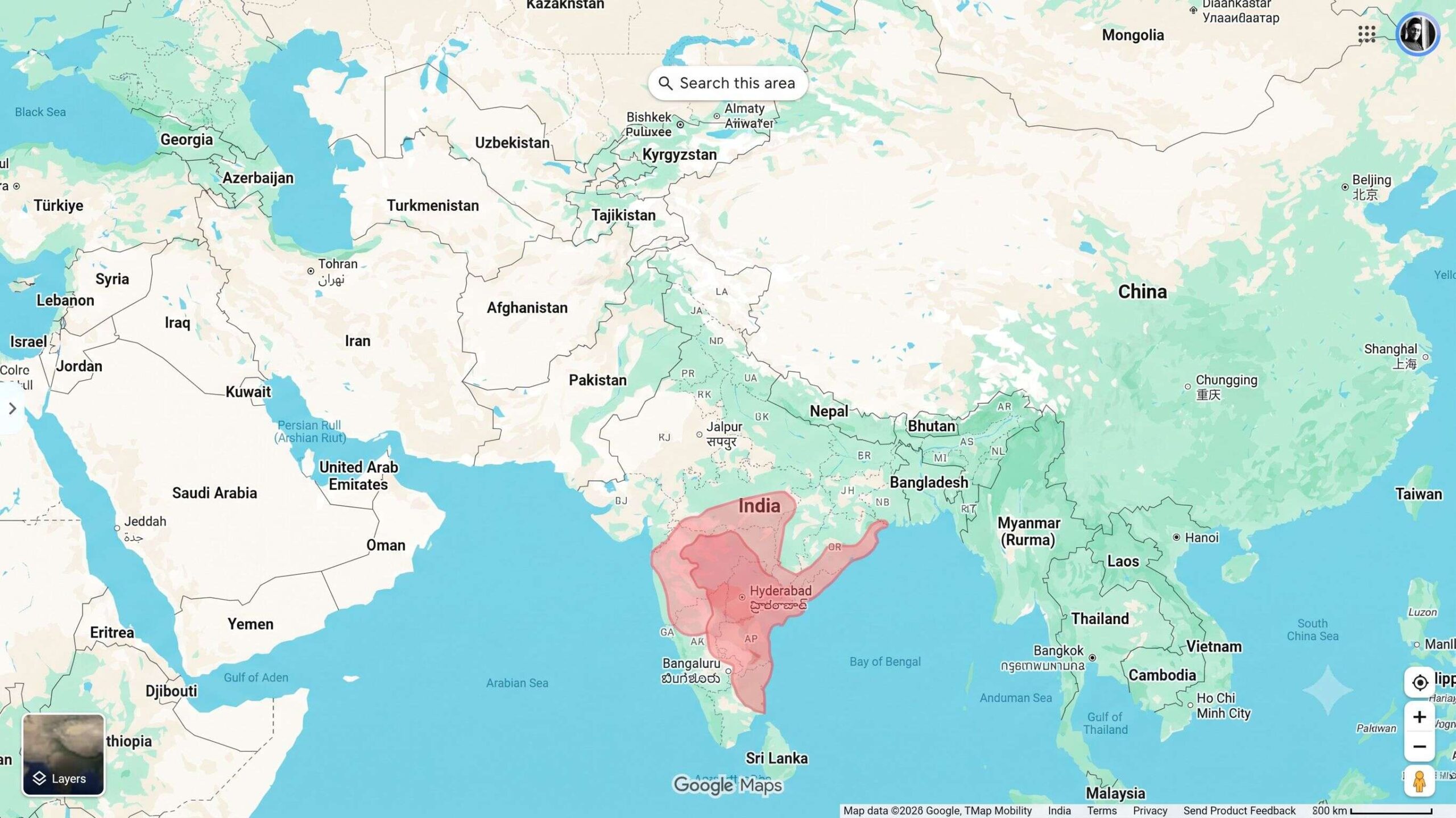
The image shows two distinct shades :
- Inner, Darker Rose Area: Represents the core, directly administered domain of Hyderabad State—primarily the Deccan plateau region encompassing parts of modern Telangana, Marathwada (Maharashtra), and Hyderabad-Karnataka (around Gulbarga/Raichur).
- Outer, Lighter Rose Area: Represents the maximum historical sphere of influence and vassal states during the Nizam’s peak under Nizam-ul-Mulk Asaf Jah I (c. 1724–1748). This broader extent included the Northern Circars along the Andhra coast, Berar to the north, and the Carnatic region (extending south toward Arcot/Tamil Nadu), which paid tribute or recognized nominal Asaf Jahi authority before later being ceded to European companies and neighboring powers.
The Nizams’ territories changed over time through warfare, treaties and agreements with the Mughal Empire, the Marathas, Mysore and the British. The historical Hyderabad State of the later princely period was centred on the Deccan Plateau. Its territory corresponds principally to areas in three modern Indian states: Telangana, Maharashtra and Karnataka. The dynasty’s wider eighteenth-century claims and influence sometimes extended beyond the boundaries of the later princely state, so these areas should not be treated as having all been governed under identical conditions throughout the dynasty’s history.
1. Telangana
The political heartland of Hyderabad State, including Hyderabad city and major surrounding districts. The region retained a distinct identity after the former princely state was reorganised in 1956 and became the modern state of Telangana in 2014.
2. Maharashtra — Marathwada
The Marathwada region, including areas around present-day Chhatrapati Sambhajinagar (formerly Aurangabad), Nanded, Parbhani, Beed, Latur and Dharashiv (formerly Osmanabad), was part of Hyderabad State before being transferred to Bombay State in 1956. It became part of Maharashtra in 1960.
3. Karnataka — Kalyana Karnataka
Areas corresponding to present-day Bidar, Kalaburagi (Gulbarga), Yadgir, Raichur, Koppal and parts of the surrounding region were associated with Hyderabad State. Most of these territories became part of Mysore State in 1956, which was renamed Karnataka in 1973.
What about Berar and neighbouring regions?
Berar, largely corresponding to parts of modern eastern Maharashtra, has a special status in this history. It was associated with the Nizam’s dominions but came under British administration in the nineteenth century and was not part of Hyderabad State in the same way as its core territories. It is therefore important not to present all of Berar as continuously governed directly by the Nizams.
Likewise, the Nizams’ political influence in the wider Deccan sometimes reached into neighbouring territories, but influence, military occupation, tributary arrangements and direct administration were not the same thing. The three modern states listed above represent the clearest geographical framework for understanding the former princely state of Hyderabad.
The Downfall of the Nizams: From Princely Sovereignty to Integration with India
The end of the Nizams’ political rule resulted from the decline of British power in India and the political crisis surrounding independence in 1947. For much of the nineteenth and early twentieth centuries, Hyderabad remained a princely state under British paramountcy: the Nizam retained authority over internal administration, but British influence heavily constrained his foreign relations and military independence. When British rule ended in August 1947, Mir Osman Ali Khan, Asaf Jah VII, sought to preserve Hyderabad’s independence rather than immediately join either India or Pakistan. Hyderabad and India signed a Standstill Agreement in November 1947, intended to maintain existing arrangements while negotiations continued. However, tensions escalated over Hyderabad’s political future, internal unrest, armed groups and the breakdown of negotiations. In September 1948, the Indian government launched a military operation known as Operation Polo. Indian forces entered Hyderabad on 13 September, and the Nizam’s forces surrendered on 17 September 1948. Hyderabad was subsequently integrated into the Indian Union. Osman Ali Khan remained a prominent figure for a time, serving as Rajpramukh (constitutional head) of Hyderabad State from 1950 until its reorganisation in 1956. His death in 1967 came long after the end of his effective political rule. The formal recognition of princely titles and associated privileges was abolished by the Indian government in 1971. Thus, the Asaf Jahi dynasty’s rule over Hyderabad ended in 1948, although the family continued to exist after the loss of sovereign authority.
Additional Historical Context
Hyderabad was a princely state, not a British province
Hyderabad was one of the largest princely states in British India. Unlike territories administered directly by the British colonial government, it retained its own ruler, court and internal administration, although British paramountcy limited its independence. This distinction is essential to understanding why Hyderabad’s future became a major political issue in 1947.
The Nizams and the British
The relationship between Hyderabad and the British changed substantially during the dynasty’s history. The early Nizams competed with the Marathas, Mysore and European powers for influence in the Deccan. Under Asaf Jah II, Hyderabad entered into a Subsidiary Alliance with the British in 1798–1800. British troops were stationed in the state, and the Nizam’s freedom to conduct independent foreign policy was severely restricted. The alliance helped protect the dynasty against some external threats but also increased its dependence on British power.
Was Hyderabad one of the richest states in India?
Hyderabad was widely regarded as one of the wealthiest princely states, particularly under Mir Osman Ali Khan. Its wealth rested on agricultural revenues, landholdings, commerce, financial assets and valuable collections of jewels. Yet the state’s wealth did not mean that all its inhabitants shared equally in prosperity. Access to education, public services and political representation varied considerably across social groups and regions.
