

Introduction: Origins, Identity and Military Power
The Mughal Empire was one of the most influential empires in the history of the Indian subcontinent. Founded in 1526 by Babur, a Central Asian ruler descended from Timur (Tamerlane) on his father’s side and tracing his maternal ancestry to Genghis Khan, the empire combined Central Asian, Persian and South Asian political and cultural traditions. The name Mughal derives from Mongol, although the dynasty’s identity and governing culture were strongly shaped by its Timurid heritage and Persianate traditions. The early Mughals spoke Chagatai Turkic within their Central Asian cultural environment, while Persian became the principal language of imperial administration, literature and court culture. The ruling dynasty was Muslim, adhering to Sunni Islam, but its religious policies varied considerably between rulers, ranging from Akbar’s extensive experiments in interfaith accommodation to Aurangzeb’s more explicitly Islamic approach to governance. The empire’s military strength rested on cavalry, mounted archers, firearms, field artillery, fortified positions and a sophisticated system of recruiting and rewarding military commanders. Over time, the Mughals developed an enormous administrative apparatus that collected agricultural revenue, maintained armies and governed a diverse population. At its height in the late seventeenth century, the empire controlled most of the Indian subcontinent and became a major centre of global commerce, architecture, craftsmanship and cultural exchange.
The Rise of the Mughals: How Babur Seized Power
The Mughal Empire was founded by Zahir-ud-din Muhammad Babur, a prince from the Fergana Valley in Central Asia, in present-day Uzbekistan. Babur initially sought to establish power in Central Asia but faced repeated setbacks in his attempts to control Samarkand. He eventually captured Kabul in 1504, giving him a strategic base from which to launch campaigns into the Indian subcontinent. In 1526, Babur invaded northern India and defeated Sultan Ibrahim Lodi of the Delhi Sultanate at the First Battle of Panipat. His army made effective use of field artillery, firearms, cavalry and battlefield tactics, helping him defeat a larger opposing force. Babur subsequently defeated the Rajput confederacy led by Rana Sanga at the Battle of Khanwa in 1527, strengthening his position in northern India. These victories established the foundations of Mughal rule, although the empire remained fragile during his lifetime. His son Humayun inherited the throne in 1530 but lost control of much of the empire to the Afghan ruler Sher Shah Suri in 1540. Humayun later regained Delhi in 1555, shortly before his death in 1556. It was his son Akbar who transformed these early conquests into a durable imperial system through territorial expansion, administrative reform and alliances with regional elites.
The Rulers of the Mughal Empire
The following table highlights the principal emperors, their reigns and their historical significance. The dates refer to periods of effective or formally recognised rule; succession disputes and periods of exile complicate some reigns.
| Time period | Ruler name | Key significance during the reign |
|---|---|---|
| 1526–1530 | Babur | Founded the Mughal Empire after defeating Ibrahim Lodi at Panipat in 1526. |
| 1530–1540; 1555–1556 | Humayun | Lost the empire to Sher Shah Suri and later reconquered Delhi with Persian support. |
| 1540–1545 | Sher Shah Suri (interregnum) | Afghan ruler who displaced Humayun; developed important revenue and road-administration systems later associated with Mughal governance. |
| 1556–1605 | Akbar | Consolidated the empire, expanded into major regions, strengthened revenue administration and incorporated Rajputs and other groups into imperial service. |
| 1605–1627 | Jahangir | Continued imperial consolidation and patronised painting, gardens and court arts. |
| 1628–1658 | Shah Jahan | Presided over monumental architecture, including the Taj Mahal and the Red Fort in Delhi. |
| 1658–1707 | Aurangzeb | Expanded Mughal territory to its greatest extent, including the annexation of Bijapur and Golconda, but prolonged Deccan wars strained imperial resources. |
| 1707–1712 | Bahadur Shah I | Attempted to manage growing regional and political challenges following Aurangzeb’s death. |
| 1712–1713 | Jahandar Shah | Short reign marked by intense court politics and struggles among competing elites. |
| 1713–1719 | Farrukhsiyar | Depended heavily on the influential Sayyid brothers, illustrating the weakening of imperial authority. |
| 1719 | Rafi ud-Darajat | Brief reign during a period of rapid succession and court factionalism. |
| 1719 | Shah Jahan II (Rafi ud-Daula) | Ruled briefly amid continuing political instability. |
| 1719–1748 | Muhammad Shah | Witnessed the invasion of Nader Shah of Persia in 1739 and the devastating sack of Delhi. |
| 1748–1754 | Ahmad Shah Bahadur | Presided over further weakening of central authority and growing regional autonomy. |
| 1754–1759 | Alamgir II | Ruled while competing Indian powers and external forces increasingly shaped imperial politics. |
| 1759–1806 | Shah Alam II | Experienced the rise of British East India Company power; the Company gained the right to collect Bengal’s revenue in 1765. |
| 1806–1837 | Akbar Shah II | Reigned as a largely ceremonial emperor under expanding British dominance. |
| 1837–1857 | Bahadur Shah II (Bahadur Shah Zafar) | Last Mughal emperor; became the symbolic figurehead of the Indian Rebellion of 1857 and was deposed by the British. |
Historical note: Sher Shah Suri belonged to the Sur dynasty, not the Mughal dynasty. His reign is included to explain the interruption between Humayun’s two periods of rule. Short-lived claimants and disputed accessions are omitted from the main succession table.
Sources for the chronology and major reigns include the Oxford Research Encyclopedia of Asian History, Encyclopaedia Iranica and Cambridge University Press historical studies.
Mughal Culture and Its Influence on the Indian Subcontinent
Mughal rule profoundly influenced the architecture, art, literature, cuisine, music, administration and urban development of the Indian subcontinent. The empire brought together Central Asian, Persian and Indian artistic traditions, producing distinctive forms of architecture characterised by monumental gateways, domes, minarets, geometric gardens, intricate stonework and elaborate decorative designs. Major examples include the Taj Mahal, Humayun’s Tomb, Fatehpur Sikri, the Red Fort and the Jama Masjid in Delhi. Mughal court patronage encouraged the development of miniature painting, illustrated manuscripts, calligraphy and refined decorative crafts. Persian became the dominant language of imperial administration and high culture, while interactions among Persian, Arabic, Turkic and local Indian languages contributed to the development of new literary traditions. Hindustani music and court performance traditions flourished under royal and aristocratic patronage, while Mughal kitchens and regional culinary practices helped shape dishes and cooking traditions now associated with Mughlai cuisine. The empire also influenced garden design, textiles, jewellery, weapon-making and the organisation of cities. Its legacy was not simply imposed from above: local artisans, architects, merchants, administrators and regional courts played essential roles in creating and adapting Mughal culture. Many of these traditions continued long after the empire’s political decline and remain visible across South Asia today.
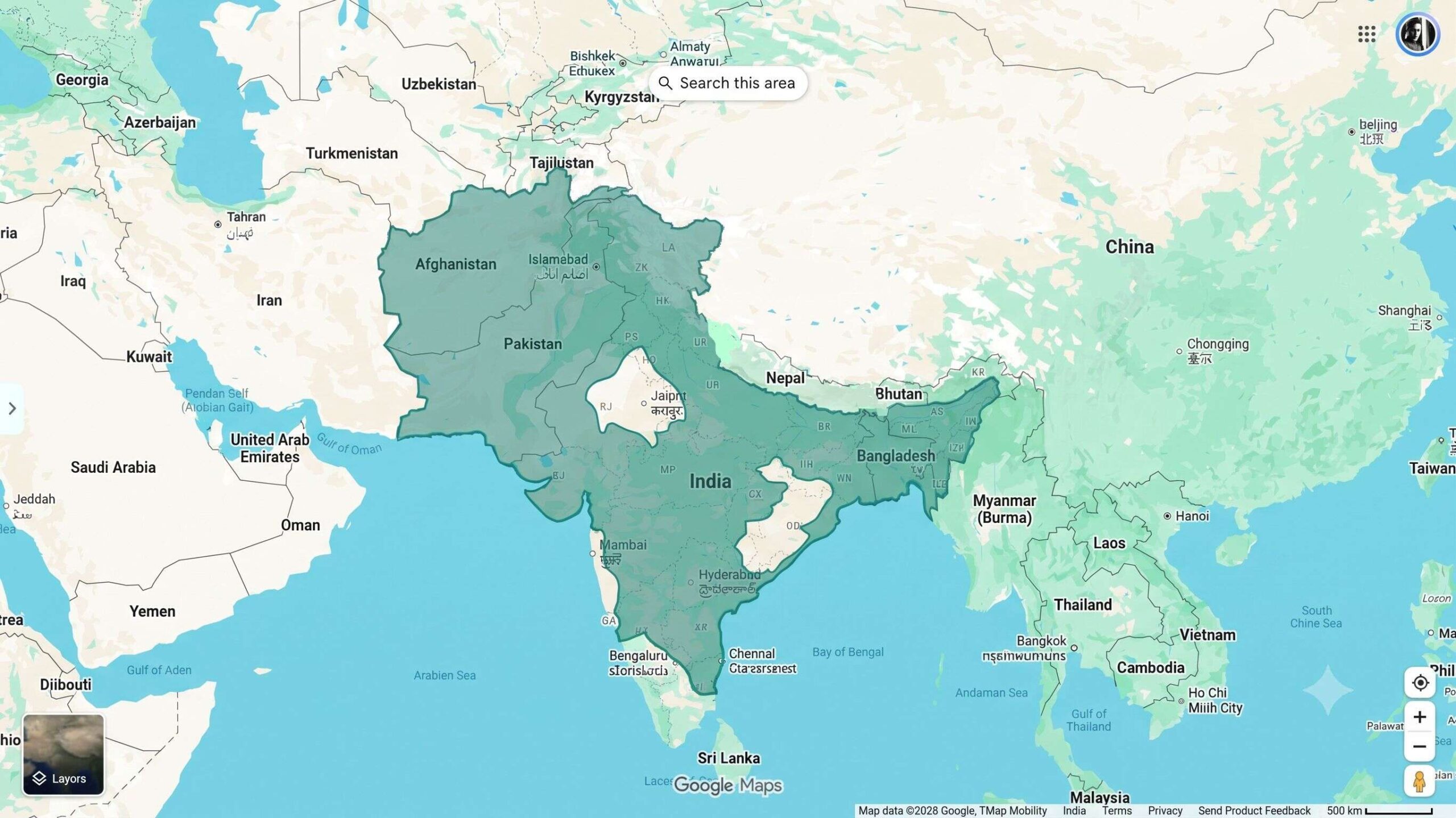
Territories Under Mughal Rule at Its Peak
The Mughal Empire reached its greatest territorial extent during the reign of Aurangzeb, particularly in the late seventeenth century and around his death in 1707. It covered most of the Indian subcontinent, although some peripheral areas remained outside direct imperial control and local rulers retained varying degrees of autonomy. The following list identifies the principal areas within the empire’s broad territorial reach, using modern geographical names for orientation. These are regions of present-day countries, not claims that the entire modern countries were Mughal possessions.
India
The imperial heartland, including Delhi, Agra, much of the Indo-Gangetic plain, Punjab, Gujarat, Rajasthan’s major territories, Bengal, Bihar, Kashmir and large portions of the Deccan. Some southern and peripheral territories remained independent or contested.
Pakistan
Major territories corresponding to present-day Punjab and Sindh, together with parts of the northwest. Mughal control of frontier regions varied over time.
Bangladesh
The historical region of Bengal, including much of the territory that is now Bangladesh, became an important Mughal province during the sixteenth century.
Afghanistan
Kabul and adjoining territories were important parts of the empire at various times, but control of the Afghan frontier changed. Kandahar was particularly contested between the Mughals and Safavid Persia.
Other important regions and frontier areas included:
- Kashmir: A strategically important northern region incorporated under Akbar.
- Assam and the Brahmaputra valley: The Mughals contested this frontier with the Ahom kingdom but never established lasting control over all of Assam.
- Parts of present-day Myanmar: No substantial territory of modern Myanmar formed part of the Mughal Empire at its peak; areas farther east were outside its effective reach.
- The Deccan Plateau: Large areas of central and southern India were brought under Mughal rule, especially through Aurangzeb’s campaigns against Bijapur and Golconda. The empire did not permanently conquer the entire southern peninsula.
Why geography mattered
The empire’s control of fertile agricultural plains, major river systems, important inland cities and commercial centres gave it a substantial economic foundation. Bengal’s textile production, Gujarat’s trading ports and the agricultural revenues of northern India were particularly important. The empire was also connected to wider commercial networks linking Central Asia, Persia, the Indian Ocean, Southeast Asia and Europe. These connections helped circulate textiles, spices, precious stones, metals and other commodities, making Mughal India an important participant in early modern global trade.
The Downfall of the Mughal Empire: From Imperial Power to British Rule
The decline of the Mughal Empire was a gradual process rather than a single military defeat. After Aurangzeb’s death in 1707, succession struggles, court rivalries, regional rebellions and the growing independence of provincial governors weakened the central government. Aurangzeb’s prolonged Deccan campaigns had expanded imperial territory but also placed heavy demands on the treasury and military. Maratha power grew, Sikh political and military organisations strengthened, and regional states such as Bengal, Awadh and Hyderabad increasingly acted independently. In 1739, Nader Shah of Persia invaded northern India, defeated the Mughal army at Karnal and sacked Delhi, carrying away enormous quantities of treasure, including the Peacock Throne. Repeated invasions and continuing internal conflicts further undermined the empire. Meanwhile, European trading companies, particularly the British East India Company, transformed their commercial presence into territorial and political power. Following the Company’s victories at Plassey in 1757 and Buxar in 1764, it secured the right to collect revenue in Bengal, Bihar and Orissa in 1765. Mughal emperors increasingly became dependent on stronger regional powers and, eventually, the British. The final turning point came during the Indian Rebellion of 1857, when Bahadur Shah Zafar became its symbolic emperor. After the rebellion was defeated, the British deposed him and exiled him to Rangoon. His removal in 1857 marked the end of the Mughal dynasty’s political rule and the transfer of governance to the British Crown in 1858.
Other Important Aspects of the Mughal Empire
Administration and economy
The Mughal Empire was not sustained by military conquest alone. It developed a centralised imperial court, a network of provincial administrations and a revenue system based largely on agricultural production. Under Akbar, officials such as Raja Todar Mal helped organise land measurement and revenue assessment. The mansabdari system assigned ranks to imperial officers and linked status, military obligations and remuneration to imperial service. These arrangements helped the state mobilise soldiers, administer large territories and collect revenue, although their effectiveness varied across time and region.
Religion and governance
Islam was the religion of the ruling dynasty, but the empire governed a religiously diverse population. Akbar pursued alliances with Hindu Rajput rulers, abolished the jizya tax on non-Muslims in 1564 and promoted a policy often described as sulh-i kul, or universal peace. Later emperors adopted different approaches. Aurangzeb restored the jizya in 1679 and pursued policies that differed from Akbar’s, while also employing Hindu officials and negotiating with various regional powers. Mughal religious policy therefore changed over time and cannot be reduced to a single uniform approach.
Trade and global connections
The empire’s agricultural wealth, textile industries and large domestic market connected it to international commercial networks. Indian cotton textiles, silk, indigo and other goods were traded across the Indian Ocean and into European markets. Silver entering through global trade helped support monetary circulation and commercial activity. Mughal India was therefore not an isolated empire: it was deeply integrated into the economic world of early modern Eurasia.
