
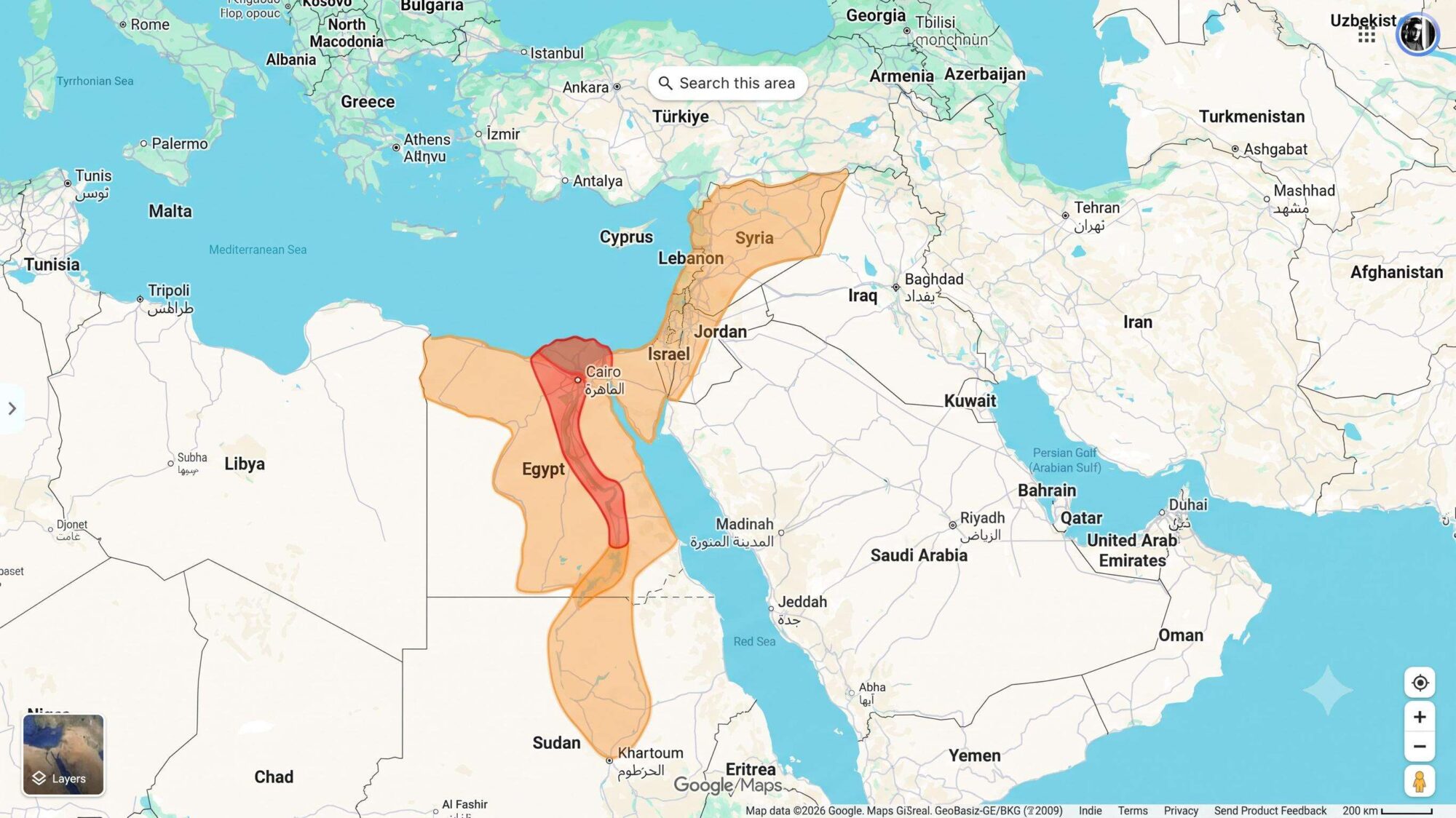
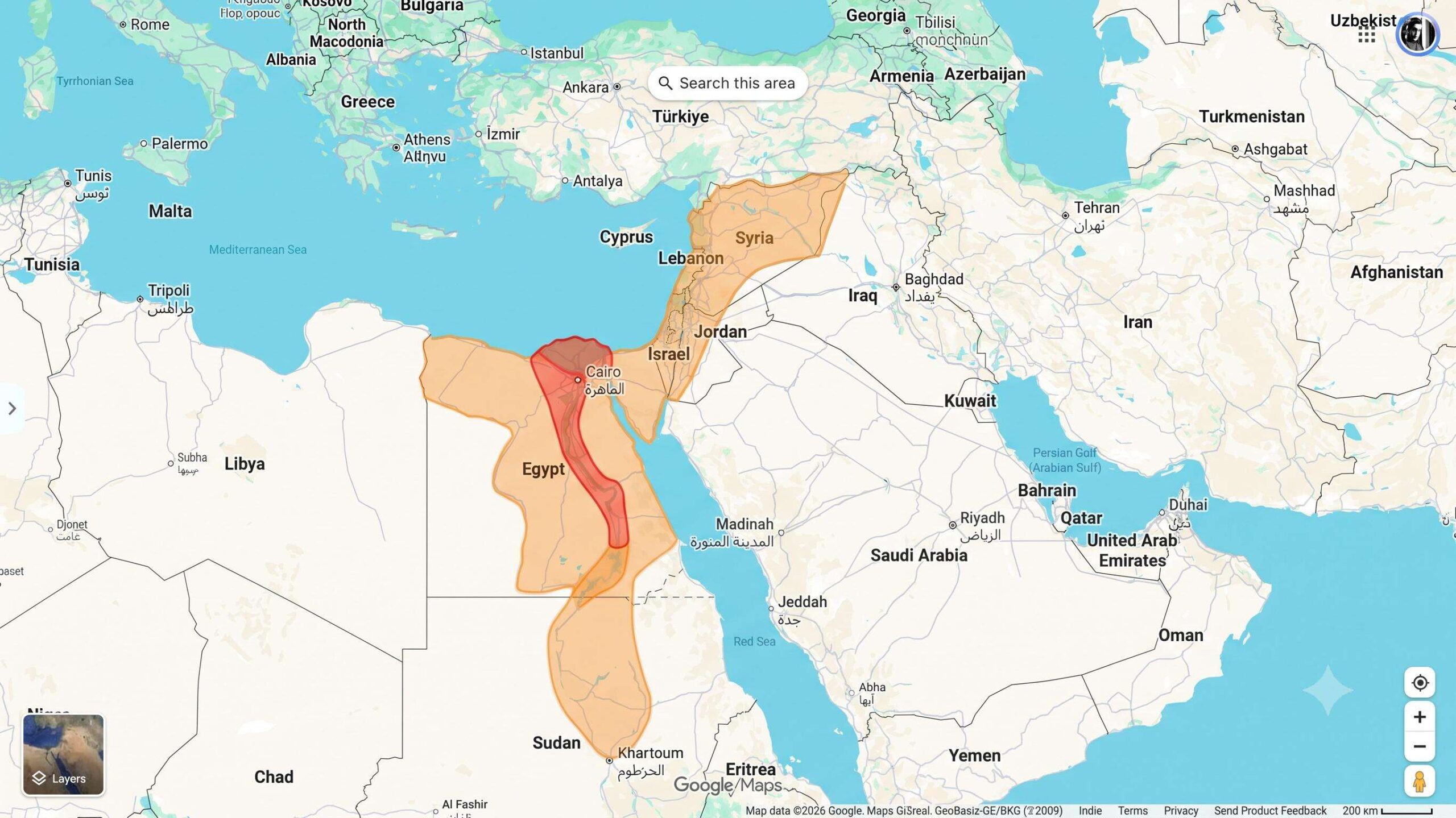
Core Regions
- Lower Egypt (Northern Egypt): Comprised the fertile Nile River Delta, stretching from just north of modern-day Cairo up to the Mediterranean Sea. Its major historical centers included Memphis, Avaris, and Alexandria.
- Upper Egypt (Southern Egypt): Comprised the narrow, long Nile River Valley running southward from south of Cairo up toward the first cataract of the Nile. Its major historical centers included Thebes (Luxor), Abydos, and Nekhen.
Expanded and Controlled Territories
- Nubia (Kush): Stretching south from the first cataract of the Nile into present-day Sudan, Nubia was frequently invaded, occupied, and integrated by pharaohs (particularly during the Middle and New Kingdoms) for its rich gold and trade routes.
- The Sinai Peninsula: Controlled for its valuable turquoise and copper mines, serving as a strategic land bridge to the Near East.
- The Levant / Canaan: During the New Kingdom, military campaigns by pharaohs like Thutmose III extended Egyptian hegemony and tribute states into parts of modern-day Palestine, Israel, Lebanon, and Syria.
- The Western & Eastern Deserts: The oases of the Western Desert (such as Siwa, Dakhla, and Kharga) and the Eastern Desert stretching to the Red Sea were under pharaonic administration and trade networks.
| Dynasty & Time Period | Major Pharaohs & Key Historical Significance |
| First Dynasty
(c. 3150 – 2890 BCE) |
• Narmer: Unified Upper and Lower Egypt into a single centralized state; commemorated on the Narmer Palette; founded Memphis as the administrative capital.
• Hor-Aha: Consolidated the unified realm; expanded trade networks into Nubia and southern Canaan; established royal burials at Abydos. • Den: First ruler depicted wearing the Double Crown (Pschent); organized state censuses and directed mineral expeditions into the Sinai. |
| Second Dynasty
(c. 2890 – 2686 BCE) |
• Hotepsekhemwy: Restored administrative stability following dynastic discord; relocated the royal necropolis northward to Saqqara.
• Khasekhemwy: Reunited Egypt after regional civil conflict; built monumental mud-brick enclosures at Hierakonpolis and Abydos (Shunet el-Zebib). |
| Third Dynasty
(c. 2686 – 2613 BCE) |
• Djoser: Commissioned the world’s first monumental stone structure, the Step Pyramid at Saqqara, designed by his high priest and architect Imhotep.
• Huni: Constructed stepped pyramids at provincial checkpoints; fortified frontier installations near Elephantine (Aswan). |
| Fourth Dynasty
(c. 2613 – 2494 BCE) |
• Sneferu: Pioneered smooth-sided pyramid architecture; constructed the Meidum Pyramid, Bent Pyramid, and the Red Pyramid.
• Khufu (Cheops): Commissioned the Great Pyramid of Giza, the largest Egyptian pyramid and the sole surviving ancient Wonder of the World. • Khafre (Chephren): Built the second-largest Giza pyramid with its valley temple complex; widely credited with commissioning the Great Sphinx of Giza. • Menkaure (Mykerinos): Built the third Giza pyramid; renowned for finely carved greywacke royal triad statues. |
| Fifth Dynasty
(c. 2494 – 2345 BCE) |
• Userkaf: Founded the dynasty; initiated the royal tradition of constructing dedicated open-air Sun Temples to Ra at Abusir.
• Sahure: Expanded naval trading expeditions down the Red Sea to Punt; conducted military campaigns into Libya and the Levant. • Unas: First pharaoh to inscribe the Pyramid Texts—the world’s earliest known religious funerary corpus—directly onto burial chamber walls. |
| Sixth Dynasty
(c. 2345 – 2181 BCE) |
• Pepi I: Directed aggressive military expansion into Canaan and Nubia; consolidated authority through strategic alliances with provincial families.
• Pepi II: Reigned for an exceptionally long period (traditionally cited up to 94 years); his waning central control enabled provincial governors (nomarchs) to seize regional independence. |
| 7th – 10th Dynasties
(First Intermediate Period) (c. 2181 – 2055 BCE) |
• Khety series & Merikare: Era of state fragmentation, famine, and civil strife; northern kings ruled from Herakleopolis while rival nomarchs arose in Thebes; period associated with The Teaching for King Merikare. |
| Eleventh Dynasty
(Middle Kingdom begins) (c. 2055 – 1991 BCE) |
• Mentuhotep II: Defeated northern Herakleopolitan rivals from Thebes; reunified Egypt to inaugurate the Middle Kingdom; constructed an innovative terraced mortuary complex at Deir el-Bahari. |
| Twelfth Dynasty
(c. 1991 – 1802 BCE) |
• Amenemhat I: Established administrative order, moved the capital north to Itjtawy, and introduced coregencies for orderly succession.
• Senusret I: Initiated major stone rebuilding of the Temple of Amun at Karnak; dispatched large military and mining expeditions into Nubia. • Senusret III: Stripped provincial nomarchs of hereditary titles; pushed Egypt’s southern boundary past the Second Cataract and built massive border fortresses (e.g., Buhen, Semna). • Amenemhat III: Undertook major agricultural and irrigation projects in the Faiyum Oasis; constructed the Black Pyramid and the Hawara mortuary labyrinth. • Sobekneferu: The first confirmed female pharaoh to rule Egypt in her own right, concluding the Twelfth Dynasty without a direct male heir. |
| 13th – 17th Dynasties
(Second Intermediate Period) (c. 1802 – 1550 BCE) |
• Salitis & Apepi (15th / Hyksos): Western-Asiatic rulers (Hyksos) governed Lower Egypt from Avaris; introduced the composite bow, horse-drawn chariot, and advanced bronze metallurgy.
• Seqenenre Tao & Kamose (17th / Theban): Native southern rulers at Thebes who launched wars of liberation against the Hyksos; Seqenenre Tao died of battle wounds. |
| Eighteenth Dynasty
(New Kingdom begins) (c. 1550 – 1292 BCE) |
• Ahmose I: Drove the Hyksos out of the Delta, pursued them into Canaan, and founded the New Kingdom.
• Hatshepsut: Celebrated female pharaoh; reign distinguished by political peace, monumental building at Deir el-Bahari, and a trade expedition to Punt. • Thutmose III: “Napoleon of Egypt”; conducted 17 victorious campaigns across the Levant (Battle of Megiddo); expanded borders to the Fourth Cataract in Nubia and the Euphrates. • Amenhotep III: “The Magnificent”; marked the zenith of diplomatic wealth (Amarna Letters), international influence, and royal luxury (Colossi of Memnon, Luxor Temple). • Akhenaten (Amenhotep IV): Imposed radical religious changes centered exclusively on the sun-disc Aten; moved the capital to Akhetaten (Amarna). • Tutankhamun: Restored traditional polytheism and returned the royal court to Memphis/Thebes; famous modernly for the 1922 discovery of his intact tomb (KV62). • Horemheb: Former general who seized the throne, dismantled Atenist monuments, excised Amarna names from official king lists, and reorganized legal codes. |
| Nineteenth Dynasty
(c. 1292 – 1189 BCE) |
• Seti I: Reasserted imperial authority over Canaan and Syria; built the Great Hypostyle Hall at Karnak and the temple complex at Abydos.
• Ramesses II (The Great): Reigned 66 years; fought the Hittites at the Battle of Kadesh (1274 BCE) leading to the first recorded peace treaty; constructed Abu Simbel and Pi-Ramesses. • Merneptah: Repelled joint incursions by Libyans and early “Sea Peoples”; commissioned the Merneptah Stele (containing the earliest surviving historical mention of “Israel”). |
| Twentieth Dynasty
(c. 1189 – 1077 BCE) |
• Ramesses III: Last great military pharaoh; defeated land and naval invasions of the Sea Peoples; navigated the first recorded labor strikes at Deir el-Medina.
• Ramesses IV through XI: Period of economic strain, grain shortages, royal tomb robberies, and fragmentation of power to the High Priests of Amun at Thebes. |
| 21st – 25th Dynasties
(Third Intermediate Period) (c. 1077 – 664 BCE) |
• Smendes & Psusennes I (21st): Ruled Lower Egypt from Tanis, known for silver-gilded royal burials, while Theban High Priests maintained de facto control over Upper Egypt.
• Shoshenq I (22nd / Meshwesh Libyan): Chieftain of Libyan origin who militarily unified Egypt; campaigned into Palestine and plundered Jerusalem (biblical “Shishak”). • Piye & Taharqa (25th / Kushite): Nubian monarchs who conquered northward, establishing the “Black Pharaohs” dynasty; revived royal pyramid construction and clashed with the Neo-Assyrian Empire. |
| Twenty-Sixth Dynasty (Saite)
(Late Period) (c. 664 – 525 BCE) |
• Psamtik I: Expelled Assyrian garrisons using Greek and Carian mercenaries; initiated the Saite Renaissance, deliberately reviving Old and Middle Kingdom artistic styles.
• Necho II: Began construction of a canal connecting the Nile to the Red Sea; sponsored a reported Phoenician maritime circumnavigation of Africa. |
| 27th & 31st Dynasties
(First & Second Persian Periods) (525–404 BCE & 343–332 BCE) |
• Cambyses II & Darius I: Achaemenid emperors who reduced Egypt to a satrapy; Darius codified local laws and completed the Red Sea canal; Persia reconquered the country under Artaxerxes III in 343 BCE. |
| Thirtieth Dynasty
(c. 380 – 343 BCE) |
• Nectanebo I & Nectanebo II: The last native indigenous pharaohs of Egypt; defended the realm against Persian offensives and sponsored nationwide temple restorations before Nectanebo II fled in 343 BCE. |
| Macedonian Dynasty
(c. 332 – 305 BCE) |
• Alexander the Great: Conquered Egypt without armed resistance, receiving coronation as pharaoh; visited the Siwa Oasis Oracle, which acclaimed him son of Amun; founded the city of Alexandria. |
| Ptolemaic Dynasty
(c. 305 – 30 BCE) |
• Ptolemy I Soter: Alexander’s general who claimed Egypt; established the Ptolemaic dynasty; promoted the syncretic cult of Serapis; founded the Library and Museum of Alexandria.
• Ptolemy II Philadelphos: Commissioned the Pharos Lighthouse of Alexandria; sponsored the translation of the Hebrew Bible into Greek (Septuagint). • Ptolemy V Epiphanes: Reigned during severe native insurrections in Upper Egypt; his priestly honorific decree in Greek, Demotic, and hieroglyphic formed the Rosetta Stone. • Cleopatra VII Philopator: The final reigning pharaoh of Ptolemaic Egypt; formed political and romantic alliances with Julius Caesar and Mark Antony; after her defeat by Octavian at Actium (30 BCE), Egypt was annexed as a Roman province. |
Key events after the New Kingdom period: (1070 BCE – 30 BCE)
1. The Fragmentation of Power (1070 – 664 BCE)
- Libyan Dynasties: Libyan tribal leaders integrated into Egyptian society and eventually seized the throne.
- The Nubian (Kushite) Empire: Around 728 BCE, black pharaohs from the Kingdom of Kush (modern Sudan) marched north, conquered Egypt, and ruled as the 25th Dynasty. They revived traditional culture and pyramid-building.
2. Waves of Eastern Invasions (669 – 332 BCE)
- The Assyrian Sack: The brutal Assyrian Empire invaded Egypt in 669 BCE, driving out the Nubians.
- The Persian Conquest: In 525 BCE, Cambyses II of Persia annexed Egypt into the Achaemenid Persian Empire, treating the land as a mere conquered tax province.
3. The Greek Renaissance: The Ptolemaic Era (332 – 30 BCE)
- After Alexander’s death, his general Ptolemy I Soter took control, founding the Ptolemaic Dynasty.
- For nearly 300 years, Greek-speaking pharaohs ruled from the newly built, magnificent coastal capital of Alexandria.
4. The Final Fall to Rome (30 BCE)
What Happened to the Royal Bloodline after the Persian Invasion?
- End of Native Rule:Nectanebo II of the Thirtieth Dynasty was the last native ethnically Egyptian pharaoh, whose reign ended when the Persian Achaemenid Empire under Cambyses II and subsequent Persian rulers took control.
- Persian Kings as Pharaohs: The Persian Achaemenid monarchs adopted the traditional title of pharaoh, ruling Egypt as a province (satrapy) rather than continuing the local royal bloodlines.
- Temporary Native Uprisings: Local Egyptian leaders launched short-lived rebellions and occasional native dynasties, but the traditional hereditary royal families lost permanent power.
- Hellenistic and Roman Successors: After the Persians, Egypt was conquered by Alexander the Great, leading to the Greek Ptolemaic Dynasty (including Cleopatra VII), and later the Roman Empire, which abolished the pharaonic office completely.
What Happened to the empire after the Greek Invasion?
When Alexander the Great expelled the Achaemenid Persians in 332 BCE, he did not dismantle ancient Egyptian civilization—instead, he and his successors initiated a calculated policy of cultural synthesis. Following Alexander’s death in 323 BCE, his general Ptolemy I Soter took control of Egypt, establishing the Ptolemaic Dynasty (305–30 BCE).
- Legitimacy by Adoption, Not Bloodline – The Greek Macedonian kings had no genealogical ties to earlier Egyptian royal families. To secure legitimacy in the eyes of the native population, they took on full traditional pharaonic titulary. For their Greek subjects and the wider Hellenistic Mediterranean, they were minted on coins and sculpted as classical Hellenistic monarchs wearing royal diadems. For indigenous Egyptians, they were carved onto temple reliefs wearing the Nemes headdress, the double crown (Pschent), and the traditional ceremonial kilt.
- Sibling Marriage: To mimic Egyptian mythological precedents (such as the divine union of Osiris and Isis) and safeguard dynastic succession, the Ptolemies adopted royal brother-sister marriages, beginning prominently with Ptolemy II Philadelphos and his sister Arsinoe II.
- Language Isolation: Greek became the exclusive language of high state administration, law, and diplomacy. Native Egyptian remained spoken by the general populace and written in Demotic and hieroglyphs. Famously, Cleopatra VII was the only ruler of the entire 300-year Ptolemaic Dynasty who took the effort to learn and speak the native Egyptian language.
- Protection and Construction of Traditional Temples – Unlike the Persians, whom Egyptian historical memory accused of disrespecting native cults and sacred animals—the Ptolemaic rulers acted as enthusiastic patrons and protectors of Egyptian holy places.
- Patronage of the Priesthood: The native Egyptian priesthood held immense wealth, land, and local influence. The Ptolemaic crown preserved temple tax exemptions and subsidized daily rituals, animal cults (such as the Apis Bull at Memphis), and festivals in exchange for priestly decrees validating the monarchs as living gods. The Rosetta Stone (196 BCE) is a direct decree issued by native priests in Memphis celebrating Ptolemy V Epiphanes for bestowing gifts and tax reliefs upon the temples.
- Administrative and Societal Bifurcation – Power shifted completely away from traditional inland religious and political hubs (such as Thebes and Memphis) to the newly founded Mediterranean port of Alexandria. Alexandria functioned as a Greek polis, intellectual center (home to the Great Library and the Mouseion), and maritime trading capital, largely isolated from rural Upper Egypt.
- Two Parallel Legal and Social Systems – Greek immigrants held elite bureaucratic, judicial, and military posts. Native Egyptians formed the agrarian base and local administrative machinery. Legal disputes were handled in either Greek courts or traditional Egyptian courts depending on the language of the contract and the ethnicity of the individuals involved.
What Happened to the Ancient Egyptians?
- Genetic Continuity: While the political elite and royal families were replaced or assimilated by foreign conquerors (Persians, Greeks, Romans, Arabs), the general population of ancient Egyptians did not vanish.
- Modern Descendants: Genetic studies and historical records show that modern Egyptians (including both Coptic Christians and Muslim Egyptians) are the direct descendants of the ancient Egyptian population, carrying a deep continuity of local ancestry blended with historical migrations.
