
Introduction: Origin, founder, ancestry, and religion
The Ghaznavid Empire was a medieval Muslim dynasty that emerged in the eastern Islamic world during the late 10th century. Its origins lay in the military and political institutions of the Samanid Empire, which ruled much of Transoxiana and Khurasan. The dynasty was founded by Sebüktegin (r. 977–997 CE), a Turkic military commander of enslaved military origin who rose through the ranks under the Samanids before establishing an independent power base at Ghazni, in present-day Afghanistan. The Ghaznavids were of Turkic origin, although they adopted Persian administrative practices, literary culture, and court traditions. They followed Sunni Islam, and their legitimacy was strengthened by their relationship with the Abbasid caliphs in Baghdad. Sebüktegin’s son, Mahmud of Ghazni (r. 998–1030 CE), transformed the dynasty into a major regional power, extending its influence across Afghanistan, Khurasan, parts of Iran and Central Asia, and large territories in the northwestern Indian subcontinent. The empire became particularly famous for its military campaigns into India and its role in the development of Persianate Islamic culture.
How the Ghaznavids came to power
The Ghaznavids rose to power through a combination of military service, political opportunity, territorial expansion, and the gradual weakening of their Samanid overlords. Sebüktegin established himself as ruler of Ghazni in 977 CE, building a regional power base from a strategically located city connecting the Iranian plateau, Central Asia, and the Indian subcontinent. His son Mahmud consolidated the dynasty’s position after a succession struggle following the death of Sebüktegin. By defeating rival claimants and exploiting the decline of Samanid authority, Mahmud secured control over Khurasan and expanded into territories previously under Samanid influence. The Ghaznavid military relied on professional cavalry, Turkic military commanders, mounted archers, and troops recruited from different parts of the empire. Mahmud also employed military campaigns to obtain revenue, tribute, and political prestige. His repeated expeditions into the Indian subcontinent brought wealth and strengthened his military establishment, while victories against regional rulers helped establish Ghazni as one of the leading political and cultural centres of the eastern Islamic world. The dynasty’s military success, however, depended heavily on strong rulers and the continued ability to maintain armies, frontier territories, and lucrative trade and tribute networks.
Rulers of the Ghaznavid Empire
The following table lists the principal rulers of the Ghaznavid dynasty, including short-lived reigns and periods of internal conflict. Dates for some early rulers vary slightly across historical sources. The chronology is based primarily on the historical account of the dynasty by historian Clifford Edmund Bosworth in Encyclopaedia Iranica.
| Ruling date | Ruler name | Key significance during the reign |
|---|---|---|
| 977–997 | Sebüktegin | Founded the Ghaznavid dynasty as an independent regional power and expanded towards the Indian frontier. |
| 997–998 | Ismail | Succeeded his father, Sebüktegin, but lost the struggle for supremacy to his brother Mahmud. |
| 998–1030 | Mahmud of Ghazni | Greatest expansion of the empire; conquered Khurasan, expanded into Iran and northwestern India, and made Ghazni a major cultural centre. |
| 1030–1031 | Muhammad | Initially succeeded Mahmud; was overthrown by his brother Masud I. |
| 1030/1031–1040 | Masud I | Attempted to preserve the empire’s western territories but suffered a decisive defeat against the Seljuks at Dandanaqan in 1040. |
| 1040–1041 | Mawdud | Seized power after defeating Muhammad and attempted to consolidate the remaining territories. |
| 1041 | Masud II | Brief and disputed reign; details of his rule remain uncertain. |
| 1041 | Ali | Short-lived ruler whose position was challenged during dynastic struggles. |
| 1041–1050 | Abd al-Rashid | Ruled during a period of instability; was overthrown by the military commander Toghrul. |
| 1052 | Toghrul | A military usurper who briefly seized power before being defeated by Ghaznavid forces. |
| 1052–1059 | Farrukh-Zad | Restored dynastic authority and helped stabilize the state after internal conflict. |
| 1059–1099 | Ibrahim | Presided over a comparatively stable period, maintaining the dynasty’s reduced territories and strengthening relations with neighbouring powers. |
| 1099–1115 | Masud III | Continued the dynasty’s rule from Ghazni and maintained its Persianate court culture. |
| 1115–1116 | Shirzad | Brief reign marked by dynastic rivalry. |
| 1116–1117 | Arslan-Shah | Took power after a succession struggle and faced opposition from his brother Bahram Shah. |
| 1117–1157 (approximately) | Bahram Shah | Ruled for decades but faced growing pressure from the Ghurids, including the devastating attack on Ghazni in 1151. |
| c. 1157–1160 | Khusrau Shah | Ruled during the loss of much of the empire’s remaining Afghan territory and the shift of political power towards the Punjab. |
| c. 1160–1186 | Khusrau Malik | Last Ghaznavid ruler; governed from Lahore until the Ghurid conquest ended the dynasty in 1186. |
Note: The reigns of some short-lived rulers are reconstructed from incomplete or conflicting medieval accounts. The dates above are approximate where indicated, and the reign of Bahram Shah is conventionally dated 1117–1157.
Countries and regions under the empire at its peak

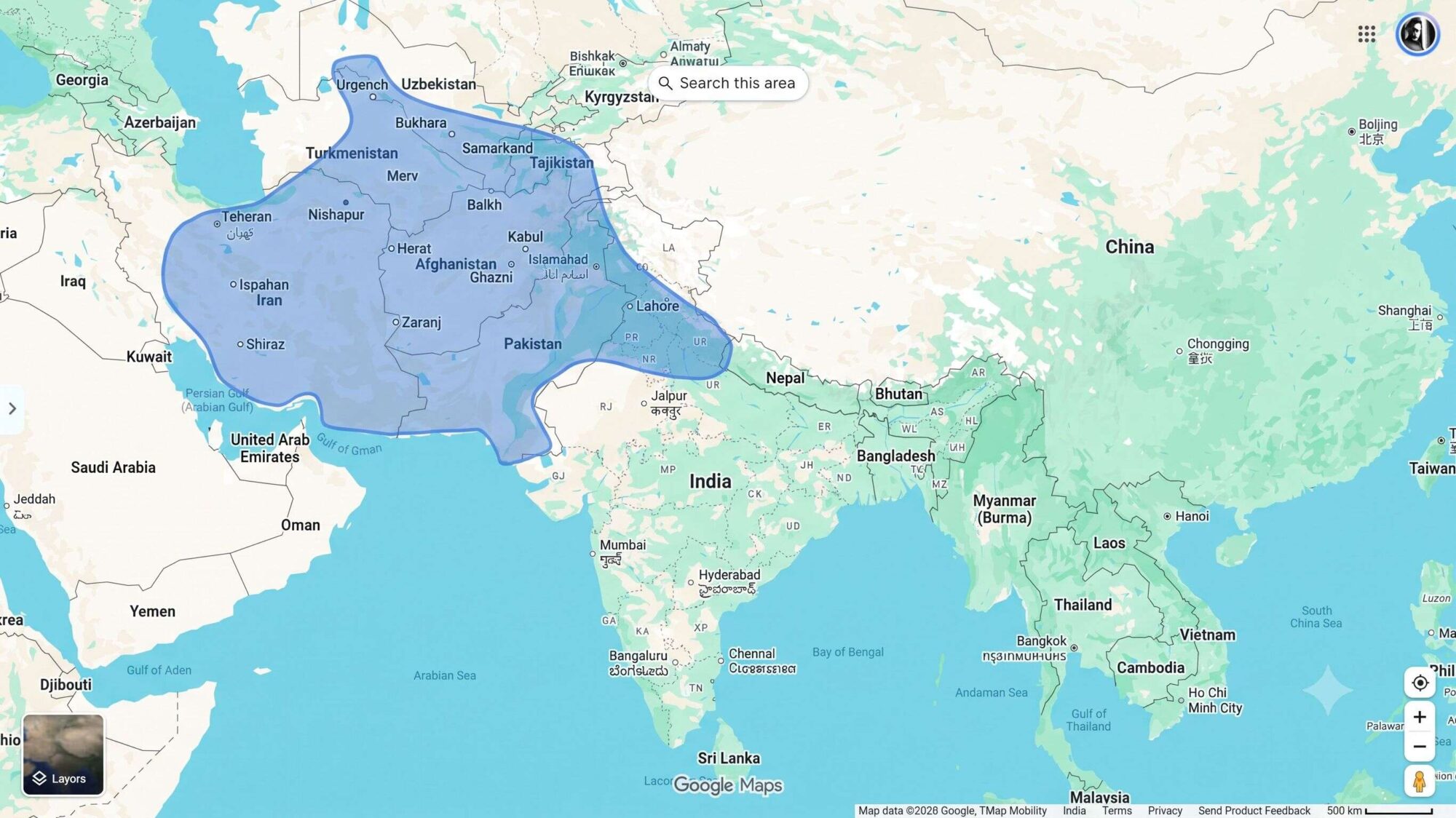
At its height, particularly under Mahmud of Ghazni in the early 11th century, the Ghaznavid Empire stretched from Central Asia and northeastern Iran to Afghanistan and the Indus region. Its influence also extended into parts of northwestern and northern India through military expeditions, tributary relationships, and provincial administration. Not every area reached by Mahmud’s armies became a permanently governed province.
The following modern countries and historical regions correspond to areas that were ruled, administered, or contested by the Ghaznavids at different points in their history.
Afghanistan
The dynasty’s political heartland, including Ghazni, Kabul and surrounding territories. Ghazni served as the imperial capital for much of the empire’s history.
Northeastern Iran and historical Khurasan
Khorasan – Madern Day Regions of:
- Iran: Northeastern provinces (such as North Khorasan, Razavi Khorasan, and South Khorasan)
- Afghanistan: Northern and western parts (including historic cities like Herat and Balkh)
- Turkmenistan: Southern and eastern parts (including the site of historic Merv)
- Tajikistan & Uzbekistan: Parts of the broader historic overlap zones
Included important cities and territories in Khurasan, such as Nishapur, Merv and Herat at different stages. Much of this western domain was lost to the Seljuks in the 11th century.
Pakistan: Punjab and adjoining regions
The Punjab, including Lahore, became increasingly important as the empire lost its western territories. Lahore eventually became the dynasty’s principal stronghold.
Central Asia: Transoxiana and Khwarazm
Tansoxiana – Modern Day Regions of:
- Uzbekistan (including major historic cities like Samarkand, Bukhara, Khiva, and Tashkent)
- Tajikistan
- Kyrgyzstan (southern parts)
- Kazakhstan (southwestern parts)
The Ghaznavids controlled or contested territories north of the Amu Darya, including parts of Khwarazm, at various times. Their authority here was temporary and uneven.
Northwestern Indian subcontinent
Parts of present-day Pakistan and adjacent areas of northern India were brought under direct control, provincial administration, tribute arrangements or temporary military occupation. The extent of permanent rule varied considerably.
Other territories affected by Ghaznavid campaigns or intermittent control included parts of Balochistan and western Iran, including Rayy and Hamadan during Mahmud’s expansion. These western acquisitions were not retained throughout the empire’s existence.
Important geographical distinction: The Ghaznavid Empire did not permanently rule all of modern India, Iran or Central Asia. Its borders changed considerably, and many territories reached during military expeditions were never incorporated into a lasting administrative system.
Cultural, intellectual, and regional influence
The Ghaznavid Empire played an important role in the spread and development of Persianate culture, Islamic scholarship, literature, and political traditions across Afghanistan, Khurasan, and the northwestern Indian subcontinent. Its legacy extended well beyond military conquest.
– Persian language and literature: Persian became a major language of courtly expression, poetry, administration and historical writing. Ghazni attracted poets and scholars, while Lahore emerged as an important centre of Persian literary culture under the later Ghaznavids. The dynasty helped strengthen a cultural tradition that subsequent Muslim dynasties in South Asia would continue to develop.
– Scientific and intellectual scholarship: The reign of Mahmud coincided with the work of scholars such as Al-Biruni, who studied Indian philosophy, religion, mathematics and natural sciences. His work Kitab al-Hind remains an important historical source on the intellectual traditions and society of medieval India. His scholarship should not, however, be understood simply as the product of imperial patronage; the circumstances of his work were more complex.
– Architecture and urban development: Ghazni developed into a prominent political and architectural centre, with mosques, palaces, monumental buildings and decorative arts reflecting Persianate and Islamic influences. The surviving Minaret of Masud III is an important architectural monument associated with the dynasty’s later period.
– Islamic institutions and Sunni political authority: The Ghaznavids reinforced Sunni Islamic institutions in their territories and cultivated ties with the Abbasid caliphate. Their political model combined military power with Islamic legitimacy and Persian administrative traditions. Their campaigns also contributed to the changing political and religious landscape of northwestern India.
– Military and political influence in South Asia: The dynasty’s campaigns established durable political connections between Afghanistan and the Punjab. However, its raids into India were often driven by wealth, tribute and strategic objectives rather than a systematic programme of territorial occupation or religious conversion. The later Ghurid conquests built upon a different phase of expansion, contributing to the establishment of the Delhi Sultanate in the early 13th century.
The downfall of the Ghaznavid Empire
The downfall of the Ghaznavid Empire resulted from a prolonged loss of territory, military defeats, dynastic instability, and the rise of stronger neighbouring powers. The first major turning point came in 1040 CE, when Masud I was defeated by the Seljuks at the Battle of Dandanaqan, resulting in the loss of Khurasan and much of the empire’s western domain. Although the Ghaznavids continued to rule from Ghazni and maintained substantial territories in Afghanistan and the Punjab, their political and economic base was considerably reduced. During the 12th century, the Ghurids, a rising power based in the mountainous region of Ghur in present-day Afghanistan, increasingly challenged Ghaznavid authority. In 1151 CE, the Ghurid ruler Ala al-Din Husayn attacked and devastated Ghazni, severely weakening the dynasty. Subsequent political upheavals and further territorial losses forced the last Ghaznavid rulers to rely increasingly on Lahore and the Punjab. Ghurid ruler Muhammad of Ghor captured Peshawar and other strategic territories before launching the final campaign against Lahore. In 1186 CE, Lahore fell to the Ghurids, and the last Ghaznavid ruler, Khusrau Malik, was captured and imprisoned. His removal ended the Ghaznavid dynasty after approximately two centuries of rule. The Ghurids inherited its remaining territories in Afghanistan and northwestern India, although their own empire would later fragment and give way to new political powers.
