
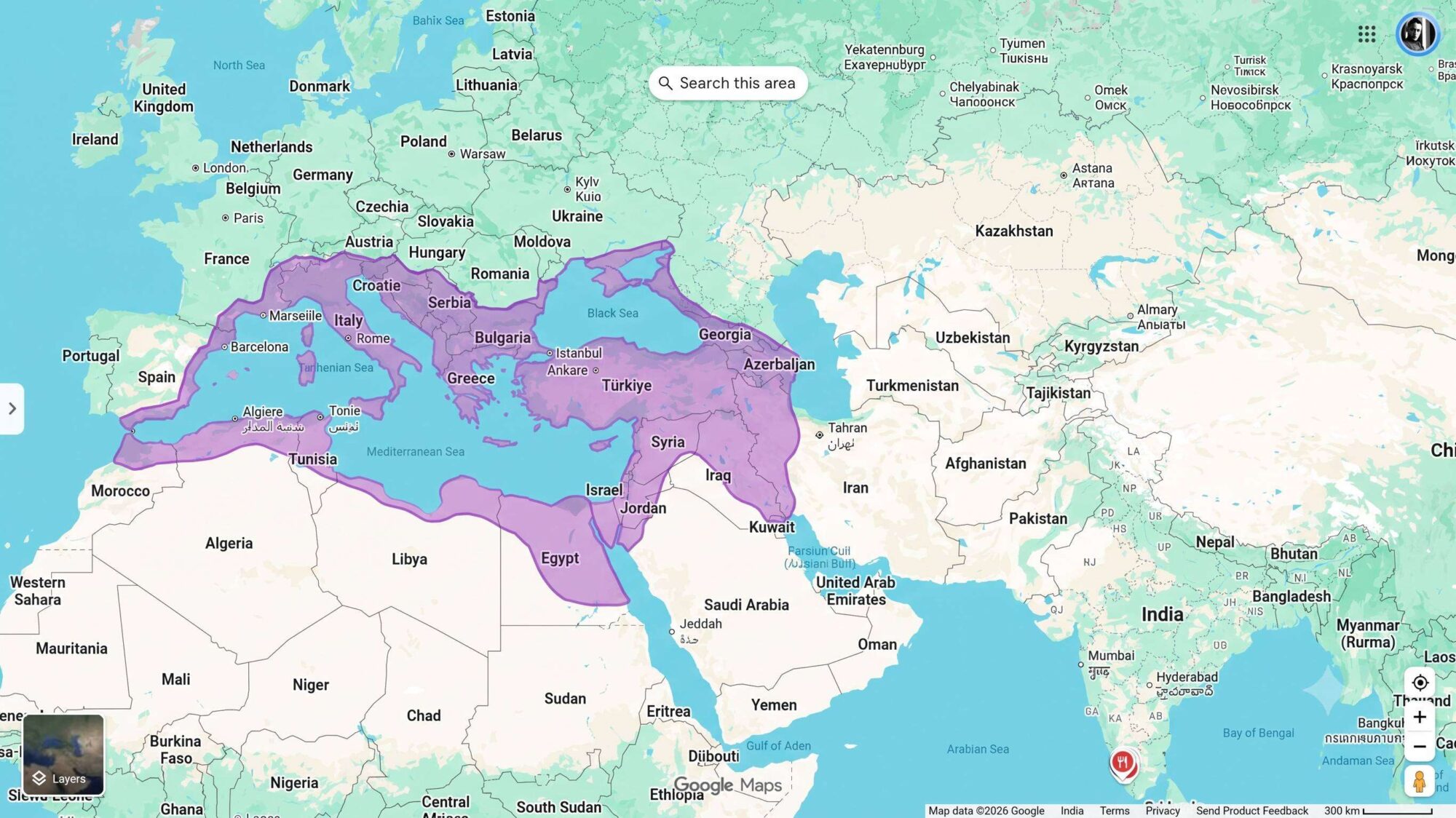
The Byzantine Empire (the Eastern Roman Empire) is the direct continuation of the Roman Empire but with a different belief system. The Byzantine Empire was a deeply Christian state. When the Western Roman Empire collapsed in 476 AD, the Eastern half of the Roman Empire—centered in Constantinople—simply kept going for another 1,000 years until 1453 AD. The citizens and emperors never used the word “Byzantine.” They called themselves Romans (Romaioi), and they viewed their government as the unbroken Roman Empire (Basileia Romaion). The term “Byzantine Empire” was invented long after the empire fell—popularized by Western historians in the 16th to 19th centuries (starting with German historian Hieronymus Wolf) to separate the Greek-speaking, Christian medieval state from ancient pagan Rome.
Governed from Constantinople (modern-day Istanbul, Turkey), founded in 330 CE by Emperor Constantine the Great on the site of ancient Byzantion.
Duration: From the division of the Roman Empire in 395 CE until the fall of Constantinople to the Ottoman Empire in 1453 CE.
Key Characteristics
Language & Culture: While Latin was the official administrative language early on, the empire was predominantly Greek-speaking and adopted Greek as its official language by the 7th century.
Religion: It was deeply Christian and served as the birthplace of Eastern Orthodox Christianity. In 1054 CE, religious and political disputes led to the Great Schism, formally separating Eastern Orthodoxy from Western Roman Catholicism.
Strategic Hub: Positioned across the Bosphorus Strait, Constantinople sat at the crossroads of Europe, Asia, the Black Sea, and the Mediterranean, making it the wealthiest trade and intellectual capital of the medieval Western world.

Major Historical Milestones
1.The Zenith under Justinian I (527–565 CE):
- Reconquered vast lost territories of the Western Empire, including Italy, North Africa, and southern Spain.
- Codified Roman civil law into the Corpus Juris Civilis (Justinian Code), which forms the basis of many modern legal systems.
- Constructed architectural marvels, most notably the cathedral of Hagia Sophia.
2. Centuries of Defense (7th–11th Centuries):
- Survived massive sieges and lost territories in the Levant, Egypt, and North Africa during the early Arab Muslim expansions.
- Rebounded strongly under the Macedonian Dynasty (867–1056 CE), pushing borders back into the Balkans, Syria, and the Caucasus while converting the Slavic peoples to Orthodox Christianity.
3. Decline and the Fourth Crusade (1204 CE):
- Pressured by Seljuk Turks in Anatolia after the Battle of Manzikert (1071 CE).
- Severely crippled in 1204 CE when Western European Crusaders diverted the Fourth Crusade to sack and loot Constantinople, shattering the empire into competing fragments.
4. The Fall (1453 CE):
- Although the empire was restored in 1261 CE, it remained economically and militarily exhausted, reduced largely to Constantinople and small pockets in Greece.
- On May 29, 1453, Ottoman Sultan Mehmed II breached Constantinople’s massive Theodosian walls using heavy cannons, ending the Roman imperial line.
Lasting Legacy
- Preservation of Ancient Knowledge: Byzantine scribes and scholars preserved classical Greek and Roman philosophy, science, literature, and law, which flowed into Western Europe to fuel the Renaissance.
- Eastern Europe & Slavic World: Byzantine missionaries introduced the Cyrillic alphabet, Orthodox Christianity, and Roman legal traditions to the Slavic peoples, including Bulgaria, Serbia, and Kyivan Rus.
- Architecture & Art: Domed basilicas, intricate glass mosaics, and iconic religious art deeply influenced Mediterranean, European, and Islamic architectural traditions.
| Reign / Period | Major Emperor(s) & Key Historical Significance |
| 306 – 337 CE | • Constantine I “the Great”: Founded Constantinople (330 CE) as the new imperial capital; legalized Christianity across the Roman Empire with the Edict of Milan (313 CE); convened the First Council of Nicaea (325 CE). |
| 379 – 395 CE | • Theodosius I “the Great”: Established Nicene Christianity as the empire’s sole official state religion (Edict of Thessalonica, 380 CE); last emperor to rule both the Eastern and Western halves of the Roman Empire before permanent political division in 395 CE. |
| 408 – 450 CE | • Theodosius II: Constructed the massive Theodosian Walls of Constantinople, which protected the city for over a millennium; codified imperial legislation into the Codex Theodosianus; founded the University of Constantinople. |
| 491 – 518 CE | • Anastasius I Dicorus: Overhauled the imperial fiscal system, introduced monetary reforms, and eliminated burdensome taxes, leaving behind an enormous treasury surplus of 23 million solidi that funded later reconquests. |
| 527 – 565 CE | • Justinian I “the Great”: Presided over the territorial apex of the Eastern Roman Empire, reconquering North Africa (Vandals), Italy (Ostrogoths), and southern Hispania; codified Roman law into the foundational Corpus Juris Civilis; rebuilt the architectural wonder Hagia Sophia. |
| 582 – 602 CE | • Maurice: Authored/sponsored the influential military treatise Strategikon; successfully conducted campaigns against the Avars and Slavs across the Danube; brokered peace with Sasanian Persia; his overthrow triggered devastating systemic instability. |
| 610 – 641 CE | • Heraclius: Defeated the Sasanian Persian Empire after a prolonged, catastrophic war (recovering the True Cross); replaced Latin with Greek as the empire’s official language and adopted the imperial title Basileus; witnessed the sudden rise of the early Islamic Caliphates and lost the Levant and Syria. |
| 641 – 668 CE | • Constans II: Reorganized imperial defense into military-agricultural districts called Themes (themata) to resist Arab incursions; temporarily relocated the imperial court to Syracuse, Sicily. |
| 668 – 685 CE | • Constantine IV: Decisively repelled the First Arab Siege of Constantinople (674–678 CE) using the devastating naval incendiary weapon Greek fire; convened the Third Council of Constantinople. |
| 717 – 741 CE | • Leo III the Isaurian: Decisively crushed the massive Second Arab Siege of Constantinople (717–718 CE); initiated the controversial first period of Byzantine Iconoclasm (banning religious icons); issued the Ecloga legal code. |
| 780 – 802 CE | • Irene of Athens: First woman to rule the empire in her own right as Basileus; convened the Seventh Ecumenical Council (Second Council of Nicaea, 787 CE) to restore the veneration of icons; her female rule was used by Pope Leo III as a pretext to crown Charlemagne as Roman Emperor in 800 CE. |
| 867 – 886 CE | • Basil I the Macedonian: Founded the prestigious Macedonian Dynasty; launched a cultural, economic, and legal renaissance; reformed imperial laws (Basilika); re-established Byzantine naval control in the eastern Mediterranean. |
| 886 – 912 CE | • Leo VI “the Wise”: Completed the comprehensive legal compilation known as the Basilika; promoted scholarly administration and formalized imperial court ceremonies. |
| 963 – 969 CE | • Nikephoros II Phokas: Renowned military tactician (“The Pale Death of the Saracens”); reconquered Crete from the Saracens (961 CE), recovered Cyprus and Cilicia, and pushed imperial frontiers deep into northern Syria. |
| 969 – 976 CE | • John I Tzimiskes: Masterful general who drove Sviatoslav I’s Kievan Rus out of Bulgaria; annexed eastern Bulgaria and launched deep campaigns into Mesopotamia and the Levant up to the gates of Jerusalem. |
| 976 – 1025 CE | • Basil II “the Bulgar-Slayer”: The pinnacle of medieval Byzantine military power; annexed the entire Bulgarian Empire; expanded imperial borders across Armenia and Georgia; secured the conversion of Kievan Rus to Orthodox Christianity; formed the legendary elite Varangian Guard. |
| 1081 – 1118 CE | • Alexios I Komnenos: Founded the Komnenian dynasty during near-total state collapse following the Battle of Manzikert (1071 CE); repelled Norman invasions; requested Western military assistance which led to the First Crusade; recovered western Anatolian coastlines. |
| 1118 – 1143 CE | • John II Komnenos: Known as “Kaloioannes” (John the Good); conducted disciplined campaigns against the Pechenegs, Hungarians, and Seljuk Turks, consolidating Byzantine power across the Balkans and Anatolia. |
| 1143 – 1180 CE | • Manuel I Komnenos: Aggressive, chivalric foreign policy; asserted Byzantine dominance over the Crusader States, the Balkans, and Antioch; clashed with the Holy Roman Empire; suffered a tactical setback against the Seljuks at the Battle of Myriokephalon (1176 CE). |
| 1204 – 1261 CE | • (Fourth Crusade Interregnum): Constantinople was sacked and occupied by Western Crusaders (Latin Empire of Constantinople); Byzantine resistance splintered into successor states: the Empire of Nicaea, the Empire of Trebizond, and the Despotate of Epirus. |
| 1259 – 1282 CE | • Michael VIII Palaiologos: Founded the Palaiologan Dynasty; recaptured Constantinople from the Latins in 1261 CE to officially restore the Byzantine Empire; outmaneuvered western coalitions through astute diplomacy (including support of the Sicilian Vespers). |
| 1341 – 1354 CE | • John VI Kantakouzenos & John V Palaiologos: Devastating civil war that depleted imperial treasuries and opened the Balkans to Ottoman Turkish expansion; period coincided with the devastation of the Black Death (1347 CE) and the Hesychast theological controversy. |
| 1391 – 1425 CE | • Manuel II Palaiologos: Eloquent diplomat and scholar-emperor; traveled across Western European courts (Paris, London) seeking military aid; survived Ottoman sieges of Constantinople before negotiating temporary peace accords. |
| 1449 – 1453 CE | • Constantine XI Palaiologos: The last Byzantine (Roman) Emperor; rejected Ottoman demands to surrender Constantinople; died heroically defending the breached Theodosian Walls on May 29, 1453, when Ottoman Sultan Mehmed II conquered the city, concluding over 1,100 years of Byzantine imperial history. |
The Fall of Constantinople: The End of the Roman Line
The Byzantine Empire reached its definitive end on May 29, 1453, when the 21-year-old Ottoman Sultan Mehmed II conquered Constantinople after a brutal 53-day siege. Reduced to an impoverished city-state surrounded by Ottoman territory, the defenders—numbering fewer than 10,000 against an army of over 80,000—were overwhelmed when massive Ottoman siege cannons shattered the ancient Theodosian Walls. The final emperor, Constantine XI Palaiologos, cast off his royal insignia and died fighting hand-to-hand in the breach, extinguishing the direct, unbroken political line of the Roman Empire that had endured for more than 1,500 years. The fall of the city sent shockwaves through Christendom, drove Greek scholars and ancient manuscripts westward to ignite the European Renaissance, and transformed Constantinople into the bustling imperial capital of the Ottoman Empire.
